RESEARCH

Statistical foundations for reliable machine learning

My work develops flexible computational methods without giving up the statistical properties needed for trustworthy inference. I am especially interested in posterior approximation, high-dimensional structure, and robustness to non-Gaussian or heavy-tailed behavior.

VARIATIONAL INFERENCE 2024–PRESENT

Component-wise tail-adaptive variational inference

Standard variational families often struggle to represent multimodal posteriors and heterogeneous tail behavior. We develop a stick-breaking mixture normalizing flow that adapts the tail behavior of each component separately, together with a new tail estimator and theoretical guarantees.

  • Flexible stick-breaking mixture construction
  • Component-wise tail transformation
  • Consistency and convergence analysis
  • High-dimensional heavy-tailed posterior experiments
CAUSAL DISCOVERY 2024

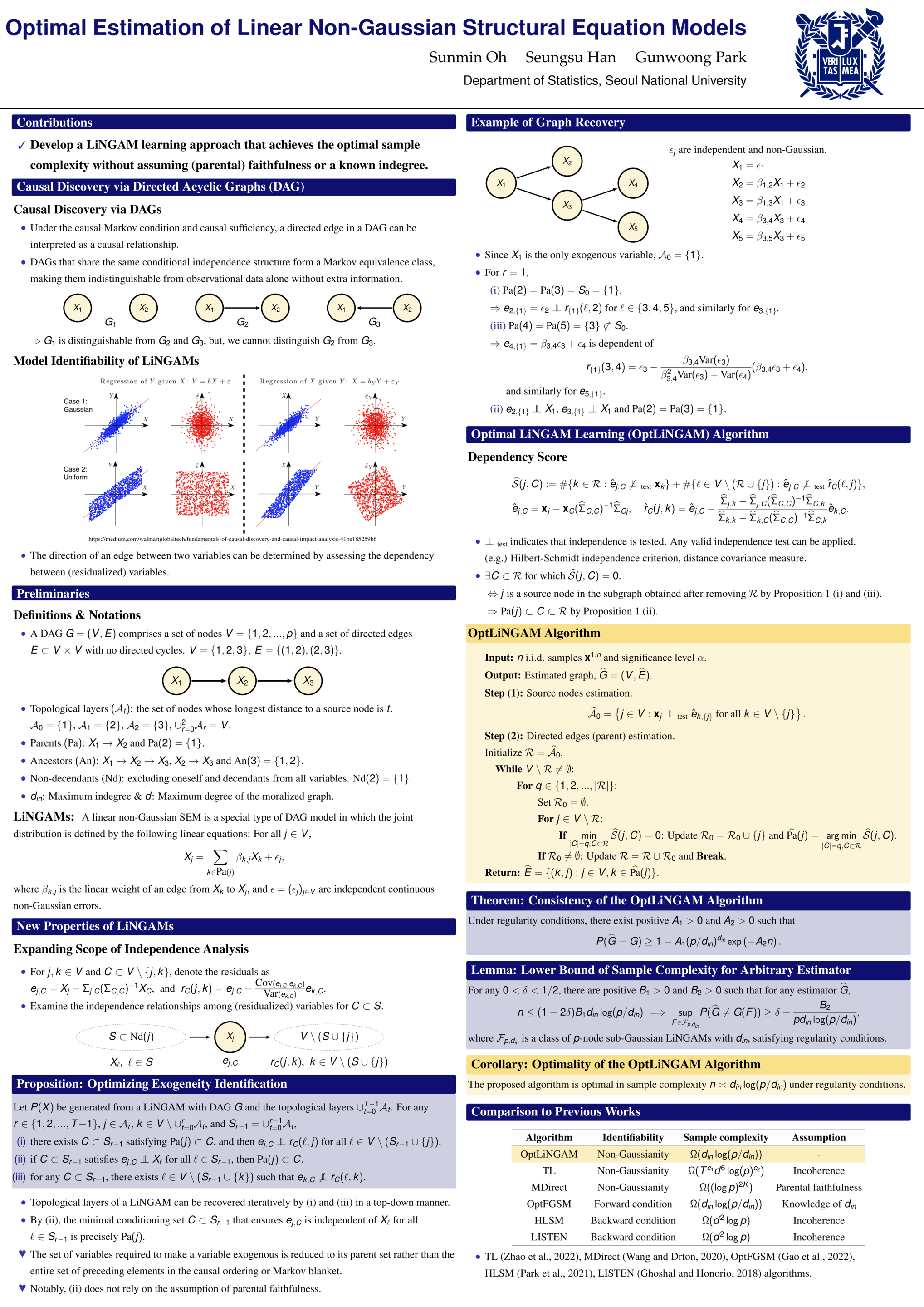
Optimal estimation of linear non-Gaussian causal models

We study structure learning for linear non-Gaussian acyclic models and establish an algorithm with optimal sample complexity. The work connects identifiability from non-Gaussianity with finite-sample guarantees for causal graph recovery.

  • Structure learning for LiNGAMs
  • Optimal sample-complexity guarantees
  • Real-data analysis using the General Social Survey
LOOKING AHEAD

Future directions

At Princeton, I hope to develop statistically principled methods for high-dimensional inference and machine learning, with particular interests in uncertainty quantification, complex dependence structures, and data-driven applications.